


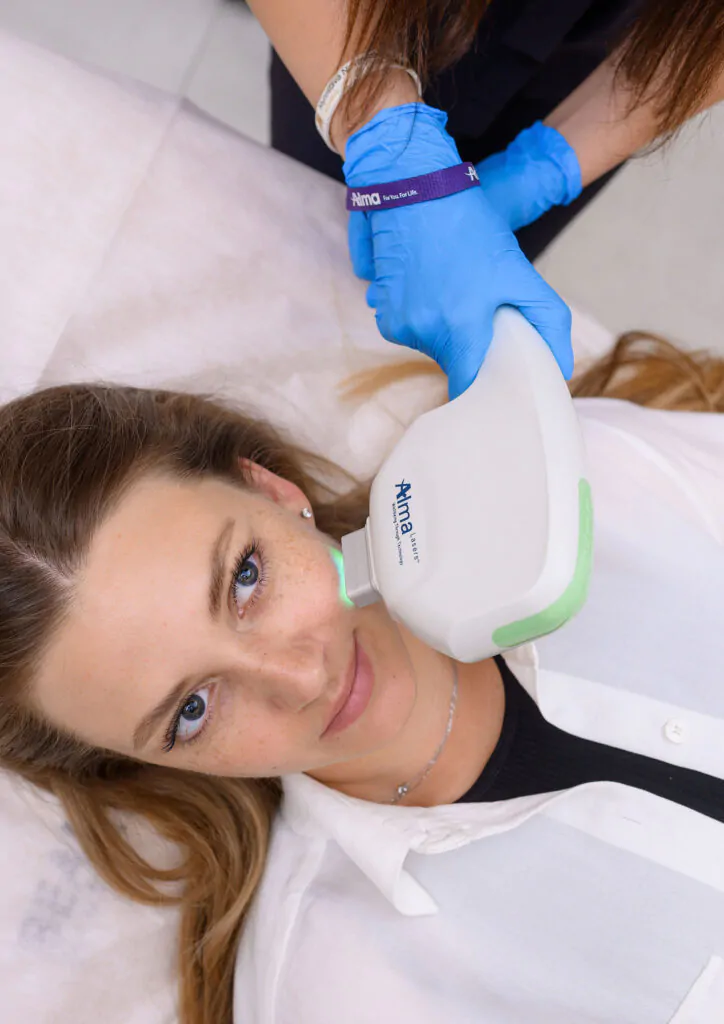
Removal of pigment spots is one of the most popular procedures at Myroslava Novosilska Aesthetic Medicine Clinic. This problem is only an aesthetic defect and in most cases does not affect health in any way. However, for many people, it causes serious psychological discomfort. Freckles at a young age and “age” pigment spots often cause one single desire – to get rid of them. The problem is complicated by the fact that pigmentation is difficult to mask with tonal means and, in the presence of age-related changes on the skin, it visually adds extra years. That’s when the developments of modern dermatology come to the rescue.
Why do pigment spots appear on the face and body?
The dark shade of the skin comes from the pigment melanin. The melanocytes that produce it are located between the superficial and deep layers of the skin. Their function is to neutralize solar radiation and prevent it from destroying the tissues of our skin, because the skin is the protective shell of the body. As soon as solar radiation begins to penetrate the dermis, melanocytes begin to produce the pigment melanin. It accumulates in the skin to absorb and neutralize the effects of ultraviolet radiation. Normally, the melanin that has formed is exfoliated over time along with the surface layer of the skin in the process of its renewal.
So, its excessive formation is overtime, and uneven deposition is manifested in the form of brown pigment spots – hyperpigmentation.
This problem can bother people of different ages and genders. Spots of different colors, shapes and sizes can be localized on the face and hands, on the chest and on the back.
At a young age, similar problems most often arise due to frequent exposure to the sun or solarium, long-term use of medications, and hormonal changes. They can also manifest due to systemic disorders of metabolic processes in the body. With age, pigment spots that appeared against the background of age-related changes in the body appear.
Causes of pigment spots appearance
We often hear the question: “Why do some people have pigment spots on their face, and others do not?” – Because everyone’s body is unique, the state of health is different, we react differently to the same external and internal causes.
These are the main causes of excessive melanin production:
- abuse of tanning (in the solarium or in the open sun);
- metabolic disorder associated with pathologies of the digestive system;
- diseases of the endocrine system;
- numerous stresses, neuroses;
- deficiency of vitamins in the body (especially vitamin C);
- hormonal changes or hormonal failures (pregnancy, lactation, menopause);
- genetic predisposition;
- taking photosensitizing drugs (some antibiotics, tetracyclines, sulfonamides, fluoroquinolones, and contraceptives).
What are the types of pigment spots?
There are several types of hyperpigmentation, some spots may appear and completely disappear depending on solar activity, others may have a constant intense color.
The most common types of hyperpigmentation are:
- Freckles. Most often, they appear on the face, shoulders, hands, that is, areas most often exposed to the sun. Their feature is that they always have a smooth surface. Freckles appear at a young age and fade independently with age.
- Chloasma, melasma. The intensity of their color often changes under the influence of light. Such pigmentation is often observed in pregnant women, as well as women with various hormonal disorders. In men, the problem occurs much less often.
- Post-traumatic and post-inflammatory hyperpigmentation. A separate category of pigmentation that occurs on injured areas of the skin and in places of inflammatory processes.
- Lentigo. They can have both a flat and a convex structure. Patients aged 40 to 50 may be diagnosed with age-related lentigo, which occurs due to excessive sun exposure, disruption of the lipid barrier of the skin, and increased permeability of the outer layer of the epidermis.
- Solar elastosis. It is one of the manifestations of photoaging of the skin, because it appears in people who abuse sunbathing.
- Vitiligo. This is a separate disease characterized by the appearance of white pigment spots on certain parts of the body, and the skin itself.
Hyperpigmentation can occur on almost any part of the face and body. In patients under the age of 25-30, pigmentation is most often located in the forehead, cheeks, nose or upper lip. In adulthood, the localization of spots is different, because the reason for their occurrence is also different – they can usually be seen on the back, chest, and outer side of the hands.
Pigment spots on the hands
 Pigmentation on the hands can be attributed to the manifestations of age-related changes in the body. Pigment spots that form at the age of 40, 50, 60 years are called Lentigo. In 90% of cases, the main reason for their appearance is the sun, because it is the areas of the hands, in various doses, that are constantly exposed to the sun’s rays. For the same reason, hyperpigmentation appears on the back, shoulders, and décolleté area.
Additional reasons for the appearance of pigmentation in adulthood are hormonal changes associated with menopause, the body’s reaction to taking some photosensitizing drugs, hypovitaminosis, stress, and some liver diseases. In addition, due to age-related changes in the body, melanin is unevenly distributed in the layers of the skin, and the skin itself loses its lipid barrier and is unable to protect itself as it did before.
Another extreme that significantly damages the skin of the hands is hypothermia and frostbite. Over time, they also lead to pigmentation disorders on the hands and appear as white spots on the skin.
Pigmentation on the hands is the result of many years of photoirradiation and quite serious internal changes. Such pigmentation lies deep in the layers of the skin, so it takes more time and effort to get rid of it. The procedures offered at the Myroslava Novosilska Aesthetic Medicine Clinic will equally effectively help to get rid of any type of hyperpigmentation.
What methods in modern cosmetology effectively remove pigment spots?
Previously, acid peels, washes, creams and masks with lightening and whitening effects were used to remove age spots. The problem with such products is that they work only on the surface, so they are unable to completely lighten pigmentation. In some cases, they do not give any effect. Fortunately, modern technologies do not stand still. Thanks to the latest developments in the field of dermatology, everyone can use an effective method of removing pigmentation.
At the Myroslava Novosilska Aesthetic Medicine Clinic, a specialist examines problem areas and selects the type of procedure individually, based on the problem and condition of the client’s skin. Among them, the best results are achieved due to:
- Laser removal of pigmentation
- Photo rejuvenation
- Skin biorevitalization
- Plasmolifting (PRP).
Laser pigmentation removal is an ideal technique to get rid of any type of pigmentation quickly, effectively and painlessly. The method works perfectly both with small single pigment spots and with large areas of pigmentation. Effectively removes pigment on body parts and on the face.
If, in addition to the correction of visible pigment, it is important for the client to achieve a complex effect of evening out the skin tone, reducing the vascular network, improving the quality of the skin, as well as preventing hidden pigmentation, the laser Photorejuvenation procedure is the optimal solution.
Biorevitalization involves the introduction of special means containing hyaluronic acid, useful vitamins and trace elements. The technique is often used to combat hyperpigmentation on the face, neck, décolleté and outer part of the hands. This method has a complex rejuvenating effect on the skin, therefore, in addition to lightening pigmentation, it will help reduce wrinkles and folds, increase the elasticity of the skin and give it a healthy, attractive color.
The Plasmolifting procedure is suitable to treat small areas of skin with uncomplicated pigmentation. Its essence lies in the injections of the client’s own plasma. The effectiveness of the technique is explained by the presence in the plasma of platelets with growth factors that stimulate renewing biochemical processes in the tissues. As a result, the dermis is restored and pigmented areas disappear or lighten. In addition, plasma lifting helps to improve skin tone and eliminate post-acne.
Laser removal of pigmentation is the most optimal procedure for targeted removal of pigmentation. For complex skin rejuvenation with the effect of lightening pigment spots, the Photorejuvenation, Plasmolifting and Biorevitalization procedures of the facial skin will show themselves perfectly. All procedures are course-based and require several sessions to whiten hyperpigmentation.
Clients often complain about pigmentation, vascular network and other aesthetic flaws at the same time. The innovative Alma Harmony XL Pro laser solves a number of dermatological and cosmetological problems. Thus, at the appointment of a dermatologist in our clinic, you can get rid of several aesthetic problems at a time.
The high efficiency of laser pigmentation removal is based on the phenomenon of selective photothermolysis – the pigment melanin absorbs the light energy of the laser, heats up under its influence and self-destructs.
Pigment spots are removed with the use of the Dye-SR module. It generates waves in the range of 550 – 650 nm, which ensures accurate energy delivery to cells with excess melanin. The laser beam, the frequency of which the doctor adjusts individually for each client, affects only excess melanin in the tissues. Such a selective effect of the laser does not affect the surrounding healthy skin cells, which excludes their traumatization.
Indications for the procedure of laser removal of pigmentation:
- pigmented scar;
- age spots;
- spots caused by excessive sunbathing;
- chloasma, melasma;
- post-traumatic pigmentation.
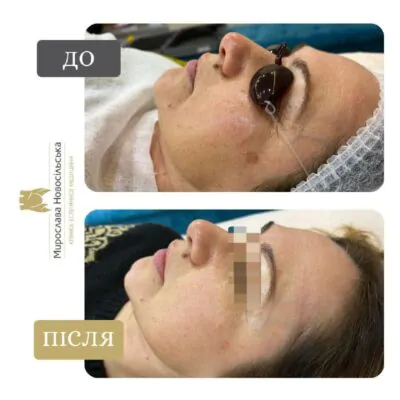
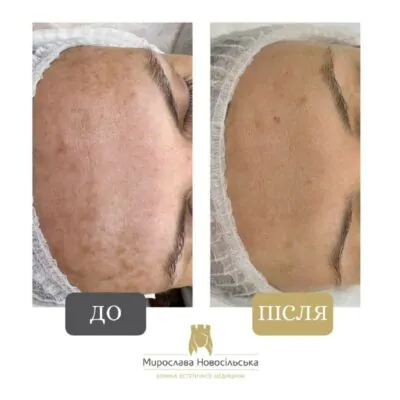
A noticeable reduction in pigmentation is evident after the first session, but to completely get rid of it, you need to undergo, on average, 2-4 procedures. After each of them, the pigment spot will become lighter and lighter until its color matches the color of the surrounding skin. The number of procedures depends on the depth of excess melanin in the layers of the skin.
How much does it cost to remove pigment spots?
The cost of removing pigment spots depends on the method of removal, size and number of sessions required for complete removal. Therefore, a specialist of Myroslava Novosilska Aesthetic Medicine Clinic, will be able to give a more precise answer to this question after examining the client during the consultation.
For example, the cost of laser removal of pigmentation on the face will cost UAH 2,300 for one session. The area of the hands will cost UAH 1,500 per session. In most cases, 2-4 procedures are required for complete removal. If the pigmentation is complex, more procedures will be required.
Plasma face lifting costs UAH 2,200. The price of biorevitalization depends on the means injected. In this case the cost may vary from UAH 4,000 to UAH 8,000 per session.
Photorejuvenation of the face costs UAH 2,500, décolletage – UAH 2,100 for one procedure.
Laser removal of pigmentation does not guarantee that it will never appear again. Especially if its occurrence is related to internal, hormonal processes occurring in the body. However, if the client follows the skin care recommendations of the dermatologist of the Myroslava Novosilska Aesthetic Medicine Clinic, he/she will enjoy an even complexion and a youthful appearance for a long time.

 UA
UA RU
RU