


Treatment of an ingrown toenail without surgical intervention in Lviv – healthy nails without pain!
Contents:
An ingrown toenail, or onychocryptosis, is a condition where the nail plate grows into the side of the nail fold. Often it occurs on one side, but sometimes on both.
This condition is accompanied by inflammation of the surrounding tissue, which can lead to serious consequences:
- redness of the skin;
- swelling of the nail fold;
- swelling of the entire toe;
- unpleasant pain that worsens when walking. (See more in the Cleveland Clinic review.)
If you don’t see a podiatrist in time, you may develop pus, hypergranulation (excess growth of soft tissue around the nail).
At the Aesthetic Medicine Clinic of M. Novosilska, a team of specialists understands nail aesthetics thoroughly. If you experience any of the above issues with toenails, it is recommended to consult a podiatrist.
You can find detailed information about prices and treatment methods for ingrown toenails at our Clinic here.
Causes of ingrown nails
It’s a misconception that the main cause of ingrown toenails is incorrect trimming. While improper trimming can deform the nail plate, it is only one of many causes:
- Ill‑fitting footwear – often seen in women wearing narrow shoes throughout the day.
- Excess weight – a rapid gain in body weight.
- Poorly done pedicure – rounded nail edges left.
- Fungal infection – affects nails and feet, leading to thickened and misshapen nail plates.
- Hereditary predisposition – nail shape on feet can be genetically determined.
- Trauma to feet that results in nail deformation.
These are the most common causes leading to an ingrown toenail.
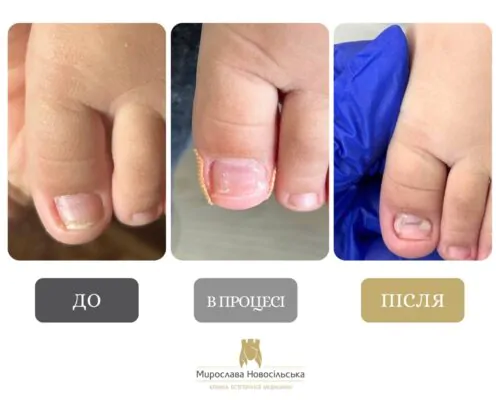
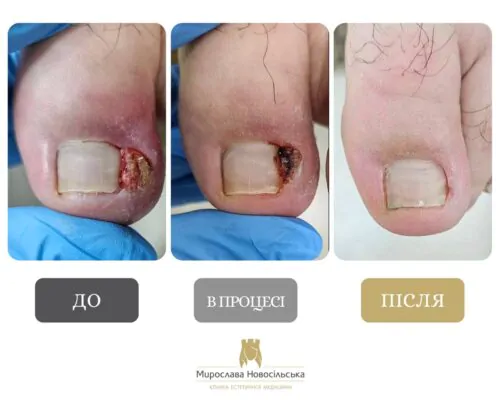
Photos of ingrown toenail treatment outcomes by the podiatrists at the Clinic of Myroslava Novosilska.
Why ingrown nails are dangerous
Beyond painful sensations, discomfort during walking, and swelling, there’s another compelling reason not to delay treatment. The trauma caused by the nail into soft tissue provokes inflammation and potential infection that may spread via the bloodstream.
Inflammation is the body’s healing response to tissue injury, hence redness. However, the vulnerable site of ingrowth can allow bacteria or pathogens to enter and spread systemically. That’s why home treatment using non-sterile tools is not recommended. When home care is not suitable and you should see a doctor – NHS advice.
Ingrown nail after surgery
If you opt for surgical intervention, be prepared for a long recovery—and the possibility that the problem may recur. If it doesn’t recur, it likely means the surgeon removed the nail matrix from which the nail regrows.
Post-operation, patients often experience significant pain in the treated area. Preventing infection in the operative zone is crucial.
The soft tissue must be treated daily with prescribed antiseptics and antibacterial ointments. Sterile dressing changes are required for 3–5 days post-op, and pain relief medication may also be prescribed.
Modern methods of treating an ingrown toenail
Here are several effective, contemporary, and safe methods for correcting an ingrown toenail (approaches and Indications for Procedures – AAFP Clinical Review):
- Laser ablation – one of the most efficient methods of correcting the nail plate. A properly executed procedure typically leads to long-term remission and normalized growth. Laser ablates targeted cells and removes excess tissue.
- Nail tamponade – one of the simplest yet highly effective early-stage methods. A podiatrist inserts a tampon-like barrier between the nail and soft tissue. This guides the nail’s growth direction. After removing the tampon, the nail no longer irritates the skin.
- Correction system installation – a reliable technique to realign the nail plate. One popular option is a titanium wire. Titanium flexes to reshape and apply gentle tension that straightens the nail.
The tamponade method is currently considered the safest and most effective, offering lasting results without surgery or pain. The nail changes its growth direction and no longer embeds into the skin.
To make an appointment with a podiatrist, click here.
Results of ingrown nail treatment at Myroslava Novosilska’s Aesthetic Medicine Clinic



How to prevent ingrown toenails
To avoid developing a common condition like onychocryptosis, follow these simple rules:
- Choose comfortable footwear that doesn’t squeeze the toes.
- Maintain hygiene: change socks regularly, wash feet with warm water and soap.
- After washing, massage and stretch your toes — from bottom to top — especially if you’ve worn closed shoes all day. This helps improve circulation in the foot.
It is also important to trim nails correctly: don’t cut them too short or round the corners. The ideal pedicure leaves a straight edge that slightly protrudes over the skin. This helps prevent the nail plate from growing into the skin.
Ingrown toenails in infants
 Children’s nails grow just like adults’, but they should not press into the surrounding soft tissues. If nails are trimmed incorrectly or broken during crawling or active movement (e.g., catching on a diaper), the edge can push into the skin, causing inflammation and pain.
At the first signs of an ingrown toenail in an infant, act promptly to avoid complications:
- Warm water to 37–40°C and add soap.
- Soak the baby’s feet for at least 10 minutes, 2 times per day.
- Dry the feet gently with a terry towel to remove all moisture.
- Carefully push the skin on both sides of the nail toward the center. Repeat several times.
This gradually frees the edge of the nail, allowing it to grow properly. The treatment course usually lasts from 3 days to 1 week.
Home treatment for ingrown toenails
It’s important to remember that home treatment is only possible at the early stage of the condition. To “release” the nail from the side fold, warm foot baths are used. Add chamomile or calendula infusions, or a weak potassium permanganate solution to the water. The optimal water temperature is 32–35°C.
If pus appears, redness intensifies, or the pain worsens, consult a specialist immediately. Advanced onychocryptosis can cause chronic inflammation and mobility issues. A qualified podiatrist will recommend the most effective treatment tailored to your symptoms.
Patient Story
Here’s an example of a complex patient case:
Oleksandr, 25 years old.
History: underwent three surgeries for ingrown toenails (two complete nail plate resections and one bilateral nail fold plastic surgery). Works 12-hour shifts standing without rest.
Complaints: constant bilateral ingrown toenails.
Examination: high, swollen folds; inflammatory process; granulation tissue; excessive foot sweating; narrow nylon shoes.
Treatment:
1) Removal of ingrown edges. 10-day course of topical anti-inflammatory agents. Antiperspirant and deodorant prescribed. Shoe change to wider leather footwear, orthopedic insole recommended. Advised to reduce load on the foot and avoid sports. Follow-up after 10 days.
2) On day 10, titanium wire installed. L-system prosthesis applied on day 20 (after folds had healed). Biweekly follow-ups.
3) Monthly wire replacement and prosthesis renewal every 1.5 months. From month 3, static physical activity allowed.
Treatment completed after 10 months with full recovery.
FAQ — Frequently Asked Questions
Is the toenail resection procedure painful?
The procedure itself is fast and almost painless (this is not a surgical nail resection, which is more complex and traumatic). Local anesthesia can be used, especially for younger patients. The most uncomfortable part is the anticipation.
How quickly does the pain go away?
Pain usually subsides quickly after the procedure — in many cases, by the next day, significant relief is felt.
How long does the recovery take?
It depends on the individual, but if you follow your podiatrist’s recommendations, recovery takes about 7–10 days. During this period, it’s important to properly care for the treated area, maintain hygiene, avoid tight shoes, and rest your foot as much as possible.
Can the problem return?
That depends on the cause. If it was due to improper nail trimming (e.g. deep corner cuts or rounded edges), or narrow shoes — then eliminating the cause usually resolves the issue.
However, anatomical features like high folds, nail curvature, flat feet, foot injuries, as well as medical conditions (e.g., diabetes, fungal infections, poor circulation), can lead to recurrence. Such cases require long-term, thorough treatment and often involve other medical specialists.

Practicing aesthetician, specialist in hardware techniques.
Certified expert at Esthederm Institute.
Work experience is over 5 years.

 UA
UA RU
RU